
If you’re evaluating customer relationship management software, HubSpot CRM almost certainly appears near the top of your search results — and for good reason. It’s one of the most widely adopted CRMs among small businesses and scaling startups. But is it actually the right fit for your team? This review breaks down what HubSpot CRM does, how it stacks up against Salesforce, whether the “free forever” claim holds up in 2026, and where it ranks among the top CRM platforms on the market.
What Is HubSpot CRM Used For?
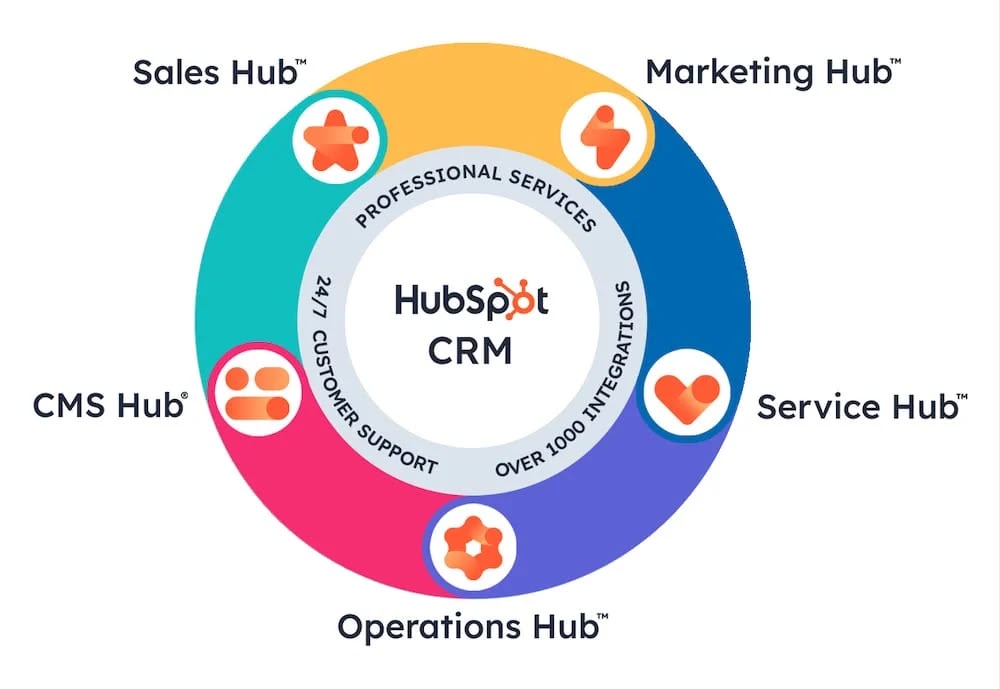
At its core, HubSpot CRM is a centralized platform for managing customer relationships across sales, marketing, and service teams. Instead of tracking leads in spreadsheets or scattered inboxes, businesses use HubSpot to:
- Organize contacts and companies in one shared database, with full visibility into every interaction
- Track deals through a visual sales pipeline, so reps know exactly where each prospect stands
- Capture leads through custom forms, landing pages, and live chat widgets
- Automate follow-ups and email sequences (on paid tiers) to keep prospects engaged without manual effort
- Run marketing campaigns including email marketing, ad tracking, and basic analytics
- Manage customer service tickets and support conversations in the same system as sales data
Because HubSpot bundles Marketing Hub, Sales Hub, Service Hub, and Content Hub under one roof, it’s especially popular with small-to-mid-sized businesses that want sales, marketing, and support teams working off the same customer data rather than juggling disconnected tools. Solo founders often use it just for pipeline tracking, while larger teams lean into its automation and reporting once they upgrade to paid plans.
Which CRM Is Better: HubSpot or Salesforce?
This is one of the most common questions CRM shoppers ask, and the honest answer is: it depends on your company size and complexity.
HubSpot CRM tends to win when:
- You’re a small business or startup that wants to get set up quickly without a dedicated admin
- You want an intuitive, modern interface with a shorter learning curve
- You need marketing and sales tools tightly integrated out of the box
- Budget matters and you want to start free before committing to paid tiers
Salesforce tends to win when:
- You run a larger or more complex sales organization with custom workflows
- You need deep customization, advanced automation logic, or industry-specific configurations
- You have (or plan to hire) dedicated administrators or Salesforce-certified consultants
- You require extensive third-party integrations through a mature ecosystem like AppExchange
In short, HubSpot is generally considered easier to adopt and better suited to growing businesses, while Salesforce is the more powerful, more customizable option built for complex enterprise sales operations — at the cost of a steeper learning curve and typically higher implementation costs. Many small businesses start with HubSpot and consider migrating to Salesforce only once their sales operations become significantly more complex.
Is HubSpot CRM Actually Free?
Yes — HubSpot’s core CRM is genuinely free with no expiration date, and it has been since 2014. There’s no credit card required and no trial clock counting down. That said, “free” comes with real limitations that have tightened over the past couple of years, so it’s worth understanding exactly what you’re getting.
What’s included for free:
- Contact, company, and deal management
- A basic sales pipeline
- Email tracking and Gmail/Outlook integration
- Lead-capture forms and basic landing pages
- A shared inbox and live chat widget
- Basic reporting dashboards
Where the free plan is capped: Free accounts are now limited to 1,000 contacts, two users, one deal pipeline, ten custom properties, and 2,000 marketing emails per month, with HubSpot branding appearing on emails, forms, and chat widgets. This is a notable change from HubSpot’s earlier, more generous free tier, which allowed up to a million contacts on older accounts. Newer accounts created in 2026 are effectively capped at around 1,000 actively marketable contacts.
For a solo founder or a very small team, these limits are often manageable. But most small and mid-sized businesses tend to outgrow the free plan within six to twelve months, typically due to the contact cap, the two-user limit, or the lack of built-in automation workflows. When that happens, businesses usually upgrade to Sales Hub Starter, Marketing Hub Starter, or a bundled Customer Platform plan, with paid tiers starting at roughly $20 per seat per month.
Bottom line: HubSpot CRM is free forever in the truest sense — there’s no bait-and-switch trial. But treat it as a genuinely useful starting point rather than a permanent solution if you expect meaningful growth in contacts, team size, or automation needs.
What Are the Top 3 CRM Systems?
While “best” depends on your specific needs, three platforms consistently rank at the top of CRM comparisons for 2026:
- Salesforce — The industry heavyweight, known for unmatched customization, a massive app ecosystem, and scalability for enterprise sales teams. Best for larger organizations with complex, multi-department sales processes.
- HubSpot CRM — The go-to choice for small businesses and startups thanks to its free entry point, intuitive interface, and integrated marketing-sales-service tools. Best for teams that want to move fast without heavy setup or admin overhead.
- Zoho CRM — A strong budget-friendly alternative offering a generous free tier for small teams and affordable paid plans with solid automation. Best for cost-conscious businesses that still want room to scale.
Other platforms worth a mention depending on your use case include Pipedrive (great for sales-focused simplicity) and Freshsales (a lightweight option with built-in AI features). Ultimately, the “top” CRM is the one that matches your team’s size, budget, and workflow complexity — not necessarily the one with the most brand recognition.
Final Verdict
HubSpot CRM remains one of the strongest options for small businesses and startups in 2026, particularly if you value ease of use and want to start free. Its limitations — capped contacts, restricted automation, and a two-user ceiling — are real, but they’re reasonable trade-offs for a tool that costs nothing to start. If your sales operation is already complex or enterprise-scale, Salesforce is worth the steeper investment. For everyone else, HubSpot is a smart place to begin.